
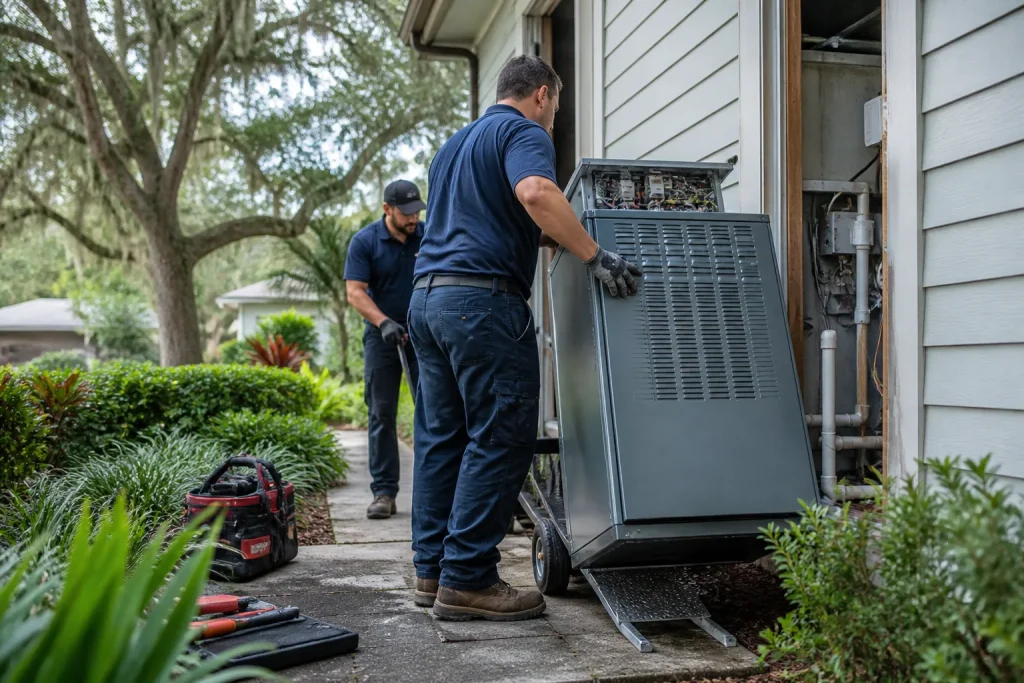
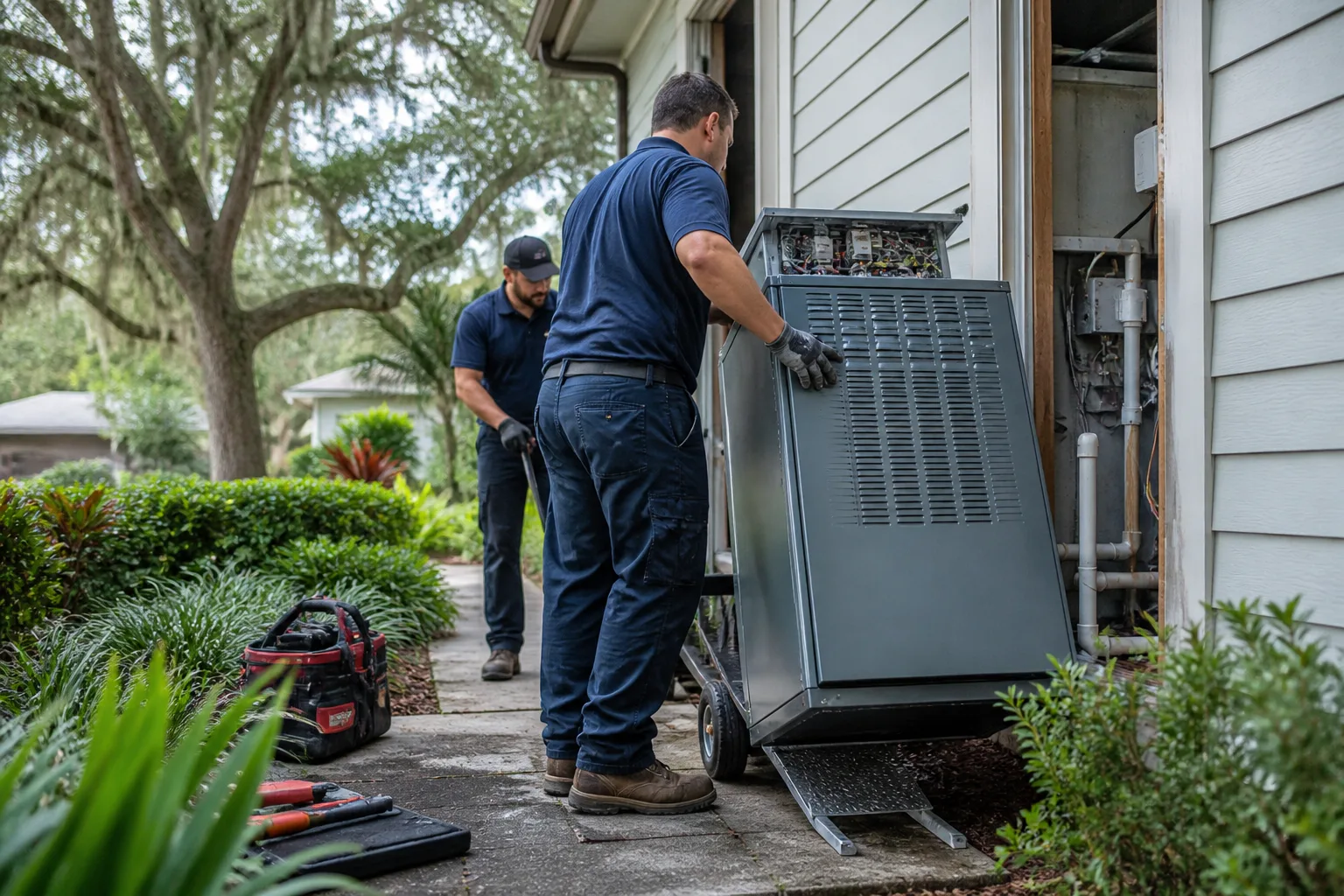
Emergency Furnace Replacement Near Me: What Gainesville Homeowners Should Do First
When a furnace quits during a Gainesville cold front, the first move is not to call around for the cheapest quote. It’s to shut the system down safely, get a working source of heat into the house, and only then start vetting contractors. The homeowners who end up overpaying are usually the ones who signed a service agreement in a 52-degree living room because it was the first call that answered. Here’s the order that protects your money and your safety.
If you’d rather not work through this alone, call (844) 223-9427 for a free estimate and a straight answer about whether your system can be repaired or needs to come out.
What should I do in the first 30 minutes after my furnace fails? (Gainesville)
Shut the furnace off at the thermostat and, if you can reach it safely, at the breaker or the emergency switch, then move people and pets into the warmest room in the house. Do not keep restarting a unit that won’t fire. A furnace that runs but never heats, or one that trips the breaker repeatedly, is telling you something needs a trained look before it runs again.
In a Florida home, “temporary heat” looks different than it does up north. There’s no basement to retreat to, and most Gainesville houses are built for cooling, so they lose heat quickly once the sun drops. Some practical steps:
- Close off unused rooms and keep everyone in one space. A small electric space heater in a closed bedroom is far safer than trying to heat the whole house with one unit.
- Never bring a gas grill, propane heater or generator indoors, into a garage, or onto a screened porch. Carbon monoxide kills quietly and it happens in mild climates as often as cold ones.
- Leave a trickle of water running on the coldest nights if the heat will be out for a while. It’s cheap insurance.
- Check the filter. A completely clogged filter can cause a high-limit shutdown that looks like a total failure. If it’s matted, swap it, reset the breaker once, and see if it holds. If it trips again, stop.
One thing to be clear about: if you smell gas, hear a crack or bang, or the unit smells like something burning, leave the house and call your gas provider or 911 first. That’s not a repair call, that’s a safety call.
What not to do with a suspected cracked heat exchanger
If you suspect a cracked heat exchanger, stop using the furnace immediately and call a technician. A cracked heat exchanger can let combustion gases, including carbon monoxide, mix into the air your family breathes. This is the one furnace problem that is never worth “watching for a few days.”
Signs that point toward a heat exchanger problem include a flame that flickers or rolls oddly when the blower starts, soot streaks near the burners, a metallic or acrid smell, and headache or nausea in the household that improves when people leave the house. Those last symptoms are easy to dismiss as a cold or a bad dinner. Don’t.
What not to do:
- Don’t run the furnace “just for a few minutes” to see if it clears up.
- Don’t tape, patch or seal anything around the heat exchanger or flue.
- Don’t rely on a plug-in carbon monoxide alarm as permission to keep running a suspect unit. An alarm is a backstop, not a clearance to operate.
- Don’t hire anyone who won’t test the heat exchanger and explain what they found.
A technician checking a heat exchanger in a Gainesville home will usually inspect it visually and test combustion, then walk you through what they saw. If they wave it off without looking, get a second opinion.
How do I vet an HVAC contractor fast during an emergency?
Ask three questions before anyone walks in the door with a service agreement: Are you licensed and insured, what brands do you work on, and can you give me a written price before work begins. A contractor who can answer those three plainly on the phone is usually a contractor who’ll be plain with you in your living room.
The three questions, in order:
- Are you licensed and insured? Ask for it to appear on the estimate. In the rush of an emergency, a homeowner in Gainesville should still know who’s responsible if something goes wrong on the job.
- What brands do you service? If the answer is a single manufacturer, that’s fine for a repair but means the replacement conversation may be steered. We work on Carrier, Trane, Lennox, Goodman, Rheem, York, Daikin, Bryant and American Standard, so the equipment recommendation comes from what fits your house and budget, not from what’s on a truck.
- Can I get the price in writing before you start? The answer should be yes. An estimate you can read beats a verbal number given in a cold room.
A few smaller signals matter too. A contractor who explains what they’re checking, gives you a clear yes-or-no on whether the unit is safe to run, and offers to hold off until you’ve had a chance to think about a replacement is being straight with you. A contractor who opens by saying “you need a new system” before looking at anything is selling, not diagnosing.
This is the moment when a lot of homeowners call us. We answer 24/7 and dispatch from 7am to 7pm, Sunday through Friday.
Emergency replacement pricing vs. standard scheduling: what’s the difference?
Emergency replacement pricing is rarely just “more expensive for the same job.” In practice, the emergency premium comes from two places: the urgency of the call, and the limited equipment choices available if a contractor has to pull from what’s on hand. A scheduled replacement, even a day later, gives you time to compare brands and get two written options.
What you should expect:
- An emergency diagnosis and a written repair estimate. This is the first step in either scenario. It’s free with us, and it’s what tells you whether replacement is even the right call.
- A clear answer on repair vs. replace. A heat exchanger crack usually means replacement. A failed igniter, a bad inducer motor, a dirty flame sensor, or a tripped pressure switch usually means repair, and often the same day. The two situations get priced very differently and should never be bundled into a single “you need a whole new system” number.
- Lead time on a new unit. Replacement equipment is ordered for your home and load. That typically means a set install date, not an install this hour. Any contractor promising same-day replacement during a cold snap in Gainesville should be able to explain exactly how, and where the unit is coming from.
When it’s worth waiting a day: if the outdoor temperature is mild, the repair is doable, or the equipment you actually want isn’t in stock and would have to be a compromise. In a mild Gainesville winter, a night or two with space heaters in a closed room is often fine while you get real quotes. When it isn’t: if the system is unsafe to run, if there are infants, elderly family members or anyone with a medical condition in the house, or if a repair would cost more than it’s worth on an old unit. Then get it moving and get it moving safely.
Why same-day replacement is rarely possible, and why that’s honest
Same-day replacement is rare because a furnace has to be matched to the home’s size, the existing ductwork, and the flue or venting setup. A reputable contractor will tell you that up front. If you’re told a new system will be in by tonight without anyone asking about square footage or seeing the existing install, ask how.
The parts of a replacement that take time:
- Load and equipment match. The unit has to be sized for the home and compatible with the existing ductwork and venting. That’s not a truck-roll decision.
- Equipment lead time. Units are ordered by model and size. A contractor with a broad brand reach can find something faster than a contractor who only carries one manufacturer, which is one reason we work with value-tier and premium brands side by side, like Rheem and Bryant, or York and Daikin.
- Permits and inspection. Most cities require a permit for a furnace replacement, so ask your city’s building department what applies to your address and let the installer handle the paperwork.
- Scheduling the install crew. Once the equipment is in and the permit is set, a furnace replacement is typically a full-day job.
What a good contractor will do honestly during an emergency: get the system safe, repair what can be repaired today, and give you a written replacement quote with a real install date. Then let you sleep on it if you want to.
What documentation should I collect during an emergency call?
Collect the written estimate, the technician’s diagnosis in writing, the make and model of anything replaced, the serial number of the new equipment, and the permit paperwork. These documents protect your manufacturer warranty and any rebate or tax credit you might qualify for, and they’re much harder to reconstruct a month later.
The checklist:
- Written diagnosis and estimate showing what was tested and what’s being replaced.
- Model and serial numbers of the old and new equipment. Photograph the nameplate on the unit before it’s hauled away.
- The contractor’s license and insurance details on the invoice.
- Permit and inspection records for the replacement, since a rebate or incentive program usually wants proof the work was permitted and done to code.
- Warranty registration confirmation, or a note of who registers the unit and when. Manufacturer warranties often start on the install date and require registration within a set window.
- Filter size and model of the new equipment, and the name of the technician who did the work, so any follow-up is easy.
Any rebate, tax credit or utility incentive has specific eligibility requirements, and those requirements live with the program, not with us. Ask the program directly and keep the paperwork in one folder. It takes five minutes and saves hours later.
When to call a pro: if your furnace won’t heat, smells off, trips the breaker, or has a suspected heat exchanger issue, don’t wait to see how it goes. Our technicians have up to 15 years of experience, and we work on the brands you already own. Repair or replace, we’ll tell you which one actually makes sense.
Related services in Gainesville: for cooling-side work in the warmer months, see AC installation; for the heating side, furnace repair; and for general cooling service, AC repair Gainesville. If you’re just learning your way around the city’s HVAC landscape, the Gainesville page is a good place to start.
The Bottom Line
The first 30 minutes after a furnace fails should go to safety, not to phone calls. Shut the unit down, get a safe heat source into one room, and keep the gas grill outside. Then vet whoever shows up with three questions: licensed, what brands, written price. Emergency replacement is rarely the right same-day call; honest contractors will tell you when a repair will get you through, and when it won’t. Get the diagnosis and estimate in writing, keep the model and serial numbers, and hold onto the permit paperwork. If you’re in Gainesville and need help, AC Repair Gainesville offers free estimates. Call (844) 223-9427. We answer 24/7, with fast dispatch from 7am to 7pm, Sunday through Friday.
Frequently Asked Questions
Usually no. Furnace replacement in Gainesville typically requires matching the unit to your home and ductwork, ordering the equipment, and pulling a permit, so a set install date is more realistic than same-day. A same-day repair is often possible for common failures like a bad igniter or flame sensor. Call (844) 223-9427 for a free estimate and a straight answer on timing.
Repair is the right call when the failure is a specific component and the system is otherwise sound. Replacement is the right call when the heat exchanger is cracked, the unit is unsafe to run, or the repair cost would be a large fraction of replacement on an old system. We offer both and can tell you which makes financial sense. Call (844) 223-9427 for a free estimate.
No. A suspected cracked heat exchanger means you should shut the furnace off and call a technician. It can allow carbon monoxide into the living space, and that is not a problem to watch over a few days. If anyone in the house has headaches, nausea or dizziness that improve away from home, treat it as urgent and call (844) 223-9427.
We work on Carrier, Trane, Lennox, Goodman, Rheem, York, Daikin, Bryant and American Standard, which covers most of the equipment installed in Gainesville homes. If your unit is one of the brands above, there’s no “we don’t service that brand” dead end. Call (844) 223-9427 for a free estimate.
Written by the team at AC Repair Gainesville.
Need HVAC Help?
Call AC Repair Gainesville - licensed & insured, here with fast help in Gainesville.
(844) 223-9427